


Difference Between ATR and ADR – What Traders Really Need to Know
In trading, you often come across the terms ATR (Average True Range) and ADR (Average Daily Range). Both indicators aim to measure a market’s volatility – but in very different ways. Mixing them up can easily lead to wrong conclusions.
The ATR was originally developed by J. Welles Wilder and measures the “true range” of a market. It not only considers the daily high-low range but also possible gaps between the previous day’s close and the current price. The ATR is calculated as a moving average (e.g., over 14 periods) and shows how much a market fluctuates on average. Traders often use the ATR for risk management, such as setting stop-loss distances or calculating position sizes.
The ADR, on the other hand, is much simpler. It only measures the average daily trading range over a chosen period (e.g., the last 20 days). Gaps are not included. This makes the ADR especially popular among day traders, since it provides a quick orientation for how much “movement potential” can typically be expected during the day.
The key difference:
-
ATR = more comprehensive, includes gaps, often used for stops and risk calculations.
-
ADR = simpler, shows only the average daily range, very useful for daily planning.
Example: If the ADR of the DAX is 200 points, a trader can expect that the index usually moves about 200 points from high to low in a typical session. However, the ATR might be slightly higher if there are frequent larger gaps in the market.
Conclusion: Both indicators measure volatility, but the ATR is more suitable for risk and money management, while the ADR gives a quick overview of the daily movement potential. Professionals often use both to gain a complete picture of market dynamics.
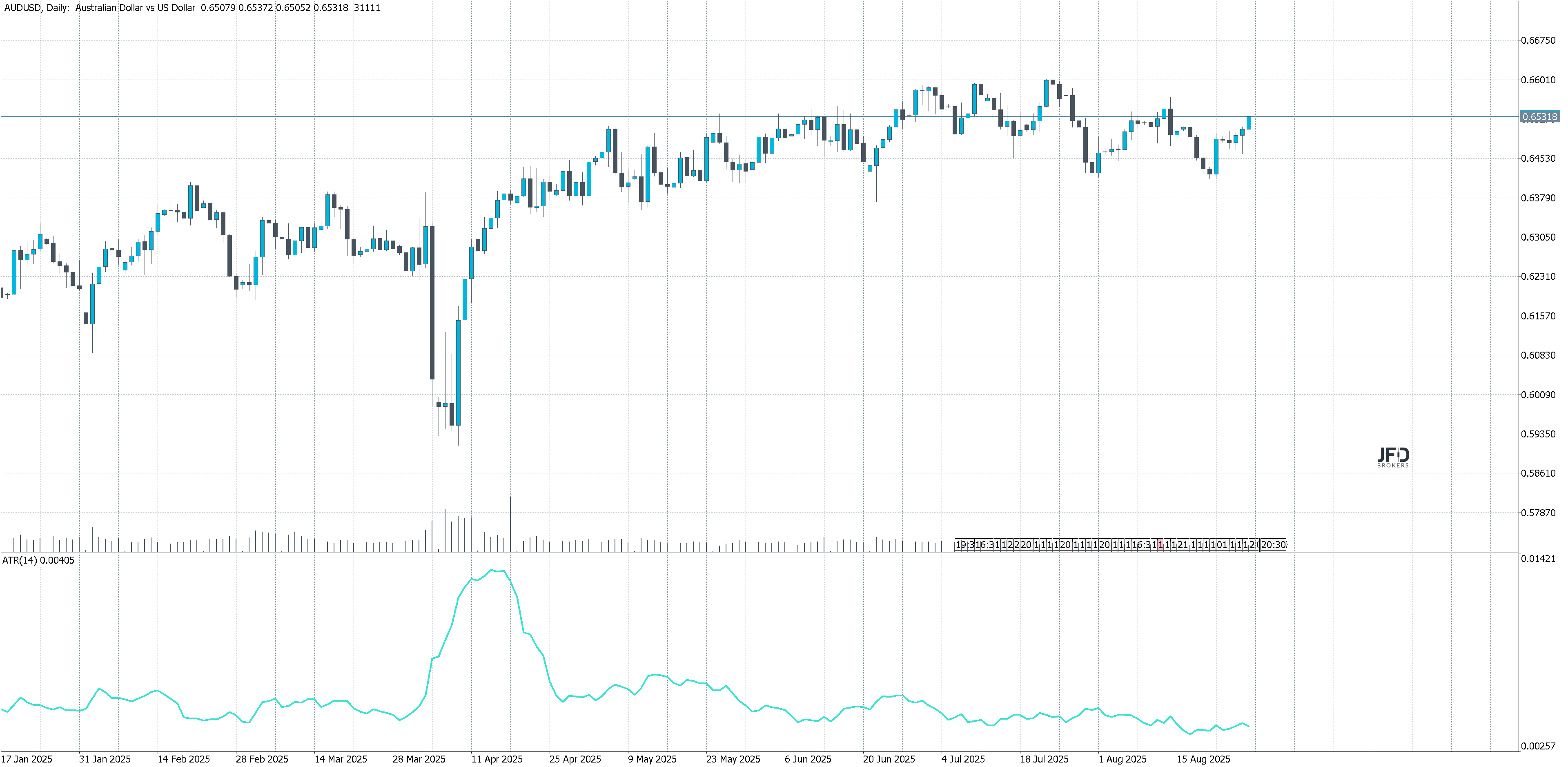
Daily chart of the AUDUSD with the ATR
Disclaimer:
The content we produce does not constitute investment advice or investment recommendation (should not be considered as such) and does not in any way constitute an invitation to acquire any financial instrument or product. The Group of Companies of JFD, its affiliates, agents, directors, officers or employees are not liable for any damages that may be caused by individual comments or statements by JFD analysts and assumes no liability with respect to the completeness and correctness of the content presented. The investor is solely responsible for the risk of his investment decisions. Accordingly, you should seek, if you consider appropriate, relevant independent professional advice on the investment considered. The analyses and comments presented do not include any consideration of your personal investment objectives, financial circumstances or needs. The content has not been prepared in accordance with the legal requirements for financial analyses and must therefore be viewed by the reader as marketing information. JFD prohibits the duplication or publication without explicit approval.
There are risks involved with trading of cash equities. Past performance is not indicative of future results. You should consider whether you can tolerate such losses before trading. Please read the full Risk Disclosure (https://www.jfdbrokers.com/en/legal/risk-disclosure).
Copyright 2024 JFD Group Ltd.